5 Important Google Algorithms Every Digital Marketer Should Know
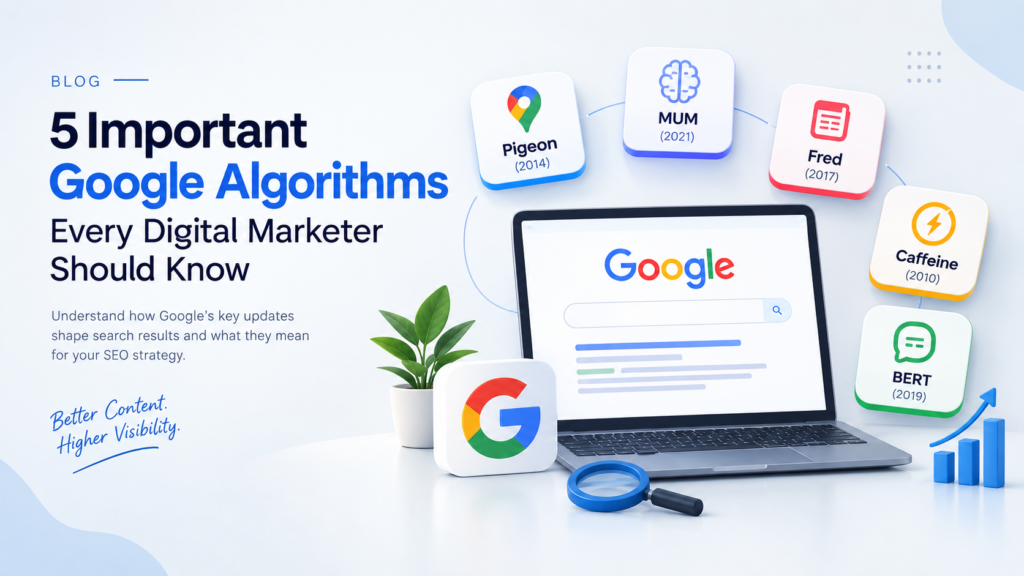
Google Search is constantly evolving to deliver more relevant, useful, and meaningful results to users. Behind every search query, a combination of algorithms and ranking systems works to understand content, context, user intent, location, and overall website quality. Over the years, several major Google updates have changed the way businesses and digital marketers approach SEO. In this blog, we’ll explore five important developments — Pigeon, MUM, Fred, Caffeine, and BERT — and understand how each one has influenced the way Google processes and presents information in search results.
Among the important Google updates are Pigeon, MUM, Fred, Caffeine, and BERT. Each one addressed a different aspect of search and influenced how websites approach SEO.
Google Pigeon
Google Pigeon was introduced in 2014 to improve the quality and accuracy of local search results.
The update made Google’s local search results more closely connected with traditional web-search ranking signals. It improved how factors such as location, distance, and relevance influence local results.
Why Pigeon Matters for SEO
Pigeon made Local SEO more important for businesses that serve customers in specific locations. Businesses can benefit by maintaining accurate business information, optimizing their websites for local searches, and building a strong local presence.
Key Focus
- Local search relevance
- Location and distance
- Local business visibility
- Better connection between web and local search
2. Google MUM
MUM, or Multitask Unified Model, is Google’s AI technology designed to understand complex information and search queries.
Unlike traditional search systems that may focus mainly on matching keywords, MUM is designed to understand information across different formats and languages. It can help Google handle complicated searches where users need information from multiple sources.
Why MUM Matters for SEO
MUM highlights the importance of creating useful, comprehensive, and well-structured content rather than simply repeating keywords.
Digital marketers should focus on understanding what users actually want and creating content that answers their questions thoroughly.
Key Focus
- AI-powered understanding
- Complex search queries
- Multiple languages
- Multimodal information
- Search intent
3. Google Fred
Google Fred is a name commonly used by the SEO industry for a major ranking update observed in 2017. Google did not officially confirm an algorithm update called “Fred.”
The update was widely associated with websites that appeared to prioritize advertising and monetization over providing useful content to visitors.
Why Fred Matters for SEO
The main lesson for marketers is simple: user experience and valuable content should come before excessive monetization.
Websites should avoid filling pages with unnecessary advertisements, low-value content, or content created mainly to generate clicks.
Key Focus
- Content quality
- User experience
- Excessive advertising
- Website value
- Avoiding low-quality SEO practices
4. Google Caffeine
Google Caffeine was a major infrastructure update launched in 2010. Unlike updates such as Panda or Penguin, Caffeine was primarily focused on improving Google’s ability to crawl, index, and serve web content quickly.
It helped Google process a much larger amount of information and provide fresher search results.
Why Caffeine Matters for SEO
Caffeine helped create a search environment where fresh and newly published content could be discovered and indexed more efficiently.
For digital marketers, this reinforced the importance of maintaining a technically healthy website and consistently publishing useful content.
Key Focus
- Faster indexing
- Fresh content
- Improved crawling
- Greater scalability
- Faster search results
5. Google BERT
BERT, which stands for Bidirectional Encoder Representations from Transformers, is an AI and natural-language processing technology introduced into Google Search in 2019.
BERT helps Google better understand the context and relationships between words in a search query.
For example, small words such as “to,” “for,” or “with” can completely change the meaning of a query. BERT helps Google interpret these words in context rather than treating each keyword independently.
Why BERT Matters for SEO
BERT makes it even more important to create content for people rather than search engines.
Instead of forcing keywords into content, marketers should write naturally, answer questions clearly, and understand the searcher’s intent.
Key Focus
- Natural language
- Search intent
- Context
- Conversational queries
- Meaning between words
Conclusion
Google’s search technology continues to evolve from simple keyword matching toward deeper understanding of content, context, intent, location, and user experience.
Pigeon highlights the importance of Local SEO, MUM focuses on complex information understanding, Fred reminds marketers to prioritize user value, Caffeine improved Google’s indexing infrastructure, and BERT improved the understanding of natural language.
For modern digital marketers, the best SEO strategy is not simply about chasing algorithm updates. It is about creating helpful, relevant, trustworthy, and user-focused content while maintaining a technically strong website.